
Peter Alexander Maximilian Bohuš
House of Bohuš est. 1231
Lux Mentis, Libertas Animae
Light of the Mind, Freedom of the Soul.
Founded in 1231, when King Andrew II of Hungary granted ancestral lands in the Liptov region to Behar, son of Samuel, the House of Bohuš was recognised in law and governance. Its first seat at Liptovské Beharovce (Curia Behar) anchored the family not only to land, but to the legal and civic order of the Kingdom — a presence carried into courts, universities, and councils across Liptov, Nitra, Spiš, and Zvolen.
Though the original 1231 charter was later lost, its force endured — reaffirmed by King Béla IV in 1262 and King Louis II in 1520. Proof that legitimacy rests not on parchment, but on continuity of law and the ancient duty to safeguard it.
The Beharovská (Behárfalva) branch to which the present line belongs became the most academically distinguished lineage of the House, producing jurists, historians, diplomats, and cultural stewards whose work shaped legal, academic, and civic life across Central Europe.
Today, that tradition continues not as nostalgia, but as responsibility. In a modern institutional landscape defined by complexity, regulation, and public accountability, the enduring commitment remains the same: to uphold clarity in law, integrity in governance, and continuity of institutional trust.

Bohuš – Est. 1231
“Lux Mentis, Libertas Animae”
A Legacy Enduring
The House of Bohuš has never relied on spectacle. Its presence has been carried forward through intellect, duty, and a cultivated sense of purpose — enduring not by volume, but by virtue.
Influence did not require volume. It required vision.
Legacy
The Beharovská Lineage and Its Scholars
Across centuries, members of the House of Bohuš — particularly those from the Beharovská (Behárfalva) branch — have contributed meaningfully to legal scholarship, historical inquiry, diplomacy, and cultural preservation.
This legacy of principled thought and public service has carried the family across generations and nations, finding expression in the law courts of Central Europe, the lecture halls of universities, and the cultural institutions.
Influence was not sought through power, but through presence — through standing for principles that safeguard others.
Notable Figures from the Beharovská Branch
-
Andrej Bohuš – Jesuit professor and legal scholar at Trnava and Zagreb; author of Minerva laureatum
-
Juraj Bohuš (Senický) – Historian, geographer, and pedagogue
-
Eugen Bohuš – Lawyer, politician, and founder of the Podtatranské Museum
-
Ivan Bohuš – Renowned 20th-century historian, with over 2,000 works across Central Europe
The Current Chapter
As a modern descendant of the Beharovská branch, Peter Alexander Maximilian Bohuš continues a tradition shaped by law, scholarship, and public duty.
Today, that heritage evolves into the AI era through Bohuš Global, where the principles of the Bohuš duty and charter are expressed in structured systems designed to support governance, institutional accountability, and the practical integrity of contractual and regulatory frameworks.
In 2025, Cambridge’s historic 1231 Writs of Protection were formally returned to the Old Schools, eight centuries after their original issue. Their return prompted renewed reflection on the continuity of scholar protections and the evolution of institutional safeguards from medieval writ to modern legal frameworks.
The enduring principle remains consistent: that institutions function best when clarity, accountability, and lawful protection are not symbolic, but operational.
Through Bohuš Global, the current chapter reflects the next step in that evolution, from written charter to systems that are structured, traceable, and accessible, ensuring that the principles of law and governance are upheld in practice, not only in form.
Bohuš Charter
1520 Charter of Confirmation

Reaffirmed under the reign of King Louis II of Hungary and Bohemia, this charter acknowledged the original 1231.
1262 Charter of Confirmation
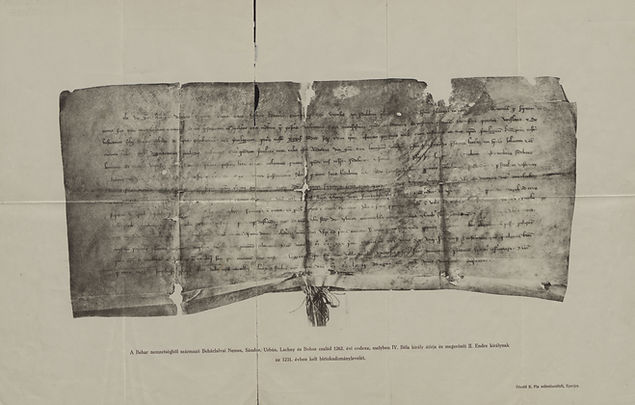
Reaffirmed under the reign of King Béla IV of Hungary, this charter acknowledged the original 1231.